Why giving kids a real business structure accelerates their financial learning
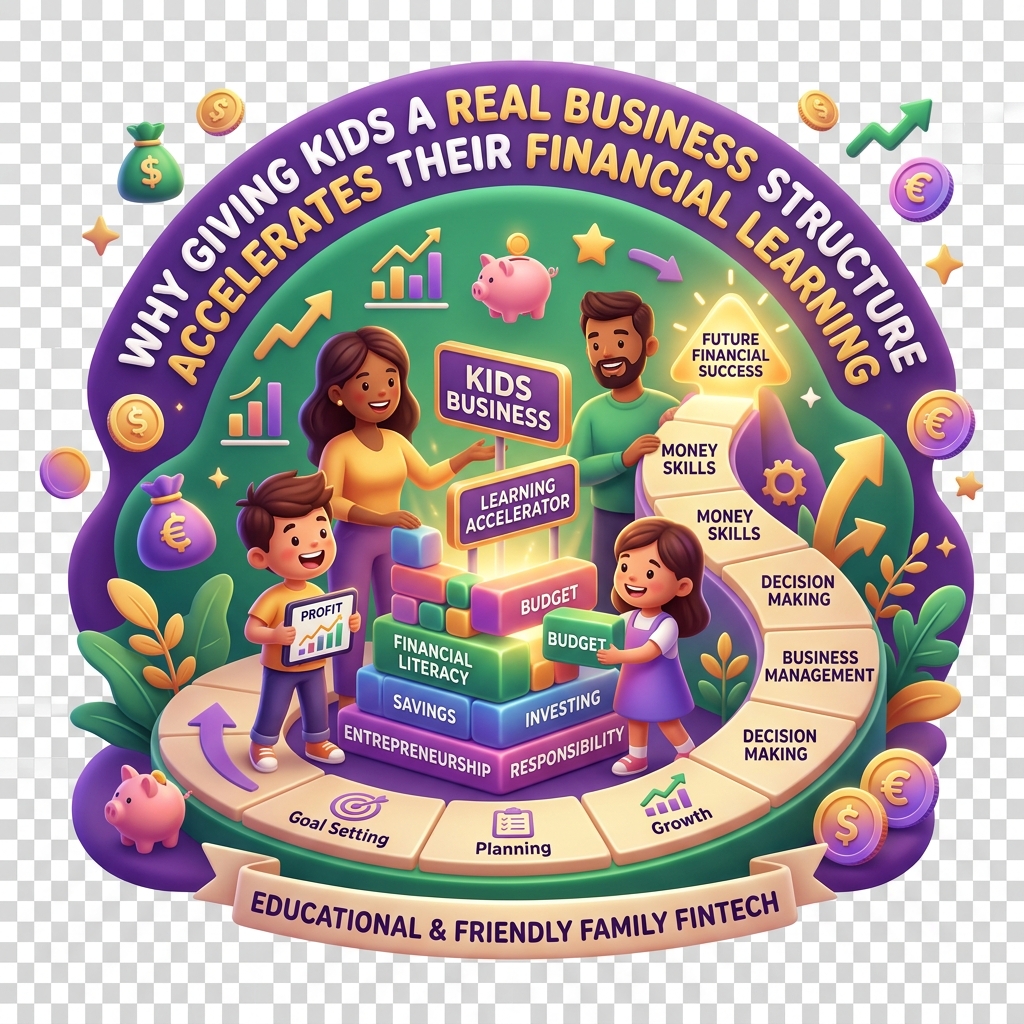
Most parents start with pocket money — a weekly or monthly allowance that lands in a child’s wallet with no strings attached. It works, up to a point. But research and real-world experience consistently show that children who manage an actual business, even a small one, develop financial skills faster and hold onto them longer. Here is why, and how KiddyCash is built to make that process practical for your family.
The problem with pocket money alone
Pocket money teaches spending. That is valuable, but it is only one piece of financial literacy. A child who receives the equivalent of 500 in your local currency every Friday learns to make that money last until the next Friday. What they do not naturally learn is where money comes from, how to price something fairly, what a cost looks like before a profit can exist, or how to handle a week when income does not arrive at all.
In a busy household in their city — or anywhere a parent is managing school fees, mobile money transfers, and daily logistics — there is rarely time to turn every allowance moment into a financial lesson. The structure has to do some of that teaching automatically.
What a business structure adds
When a child runs a business inside KiddyCash, even something as simple as a neighbourhood errand service or selling handmade cards, they encounter a different set of realities:
-
Revenue is earned, not given. The child must do something — provide a service, deliver a product — before money moves into their wallet. This single shift changes how they think about every coin.
-
Costs become visible. If your child buys supplies to make a product, those costs appear as real deductions. They see that the equivalent of 200 in your local currency in sales is not the equivalent of 200 in your local currency in profit if materials cost the equivalent of 80 in your local currency.
-
Pricing requires thinking. Setting a price too low means working for nothing. Setting it too high means no customers. Children work this out quickly when real money is involved.
-
Income can be irregular. A slow week with no sales is one of the most powerful financial lessons available. It creates the motivation to save during good weeks — something no fixed allowance can replicate naturally.
-
Accountability is built in. Inside KiddyCash, business transactions are logged, visible to you as a parent, and tied to the child’s wallet. Nothing disappears into a pocket unrecorded.
How KiddyCash supports this
KiddyCash gives your child a dedicated business space that sits alongside their personal wallet, not mixed into it. Income from the business flows in separately, so your child can see the difference between money they earned and money you gave them as an allowance.
You can set up and oversee everything from the same parent dashboard you already use to manage allowances and school contributions. You approve transactions, set limits, and watch progress without micromanaging every step.
To get started, you can create a kid-run business directly from your dashboard in a few minutes — no complicated setup required.
Once a business is running, head to KiddyCash Kiddy Business to explore the full range of tools available, including transaction tracking, earnings summaries, and badge rewards that keep children motivated.
The bigger picture
Financial literacy is not a single lesson. It is a habit built over hundreds of small decisions. A business structure gives your child more of those decisions — and more meaningful ones — than pocket money alone ever can. The earlier they start making real choices with real (small) consequences, the more confident and capable they will be when the stakes are higher.
Pocket money is a foundation. A business is where the real building happens.